One aspect of integrated resource planning is absolutely true: Utilities alone no longer determine the grid’s destiny.
Transforming the Creation of Integrated Resource Plans (IRPs)


One aspect of integrated resource planning is absolutely true: Utilities alone no longer determine the grid’s destiny.
Fully embraced by the Hawaiian Electric Companies and Green Mountain Power
Across the country, many utilities are in the midst of transitioning to the utility business model of the future. That emerging business model embraces the transition away from firm, fuel-fired central station generation—sited, owned, and operated by the few—to renewable distributed energy resources (DERs)—sited, owned, and operated by the many.
Regulatory policy in several states (California and New York immediately come to mind) governs the transitioning of a number of these utilities. On the other hand, several utilities are taking the bull by the horns (an apt metaphor given the enormity and ornery nature of this transformation) to systematically transition to the utility of the future on their own terms.
I use the term “future” loosely because, for a number of utilities, the future is already here. Two such utilities bookend the country: the Hawaiian Electric Companies—the largest investor-owned utility (IOU) in Hawai‘i—and Green Mountain Power—the largest IOU in Vermont.
Over the past several years, I have been fortunate to work with both utilities, witnessing first-hand their struggles and successes in their transition to the utility of the future. In addition, I have held an integral role in their most recent integrated resource plans (IRPs), which outline their plans for opening their doors fully to DER penetration on their power grids to pursue their goal of 100 percent renewable generation.
The Hawaiian Electric Companies.Hawai‘i was the first state to mandate a 100 percent Renewable Portfolio Standard (RPS). In their December 2016 integrated resource plan (entitled a Power Supply Improvement Plan by commission edict), the Hawaiian Electric Companies outlined their plan for achieving their 100 percent RPS goal five years ahead of the 2045 deadline.
As stated in their resource plan’s Executive Summary: “Under multiple longer-term scenarios, our RPS can be at least 72 percent by 2030 and reach at least 100 percent by 2040, ahead of the 2045 deadline. In the aggregate, our action plans estimate achieving a 52 percent RPS by 2021 by adding 326 megawatts (MW) of rooftop solar, 31 MW of Feed-In Tariff (FIT) solar generation, 115 MW of demand response (DR), 360 MW of grid-scale solar, and 157 MW of grid-scale wind resources across all five islands we serve.” The 326 MW DER represents the maximum projected amount by 2021.
Their plan also includes enabling the island of Moloka‘i to be 100 percent renewable by 2020, maximizing demand response, modernizing their grid, and preserving flexibility to accommodate emerging technologies (such as hydrokinetic energy), innovation, and changing circumstances. In other words, embracing the foundational principles incumbent to the utility of the future.
Green Mountain Power.The story of their 2018 IRP (filed in December 2018) is one of the innovation and change that is a hallmark of the utility of the future:
Change from the old energy system of centralized, fossil fuel-based generation transmitted through traditional poles and wires to customers far away, toward lower carbon, renewable, distributed generation with new, complex local and regional grid management opportunities.
Change from one-way electricity flowing from a central plant to a customer toward two-way energy information, storage, and delivery between customers and to the benefit of everyone.
Change from steady and increasing loads toward flat and declining loads, as customers choose self-generation plus energy storage and utilize beneficial energy efficiency programs.
Change from separate fuels for and treatment of thermal, lighting, and transportation energy toward convergence through the strategic electrification of resources.
It wasn’t until 2015 that Vermont passed their Renewable Energy Standard (RES) that mandated renewable energy goals. Divided into three Tiers, RES requires a total of 75 percent of retail sales by 2032 to be derived from a combination of grid-scale renewable resources and DERs. The state’s 2016 Comprehensive Energy Plancalled for attaining 90 percent of its energy from renewable resources by 2050.
Fortunately, Green Mountain Power had already embraced the utility of the future business model and was well on its way toward meeting these mandated goals. The utility also enables customers to connect storage systems to the power grid, either through their program that offered 2,000 Tesla PowerWall 2.0 batteries at a reduced price as well as any other privately-purchased BESS. Both are first-of-their-kind programs. It’s no surprise that the utility is guided by the “customer as North Star” principle.
Both utilities have thrived within the utility of the future business model. Other utilities can benefit from their lead.
—Rich Maggiani
How closely should a utility follow a commission-prescribed IRP process?
The utility had a clear problem: how to develop their current integrated resource plan (IRP). The size and scope of the problem seemed to expand daily.
The state’s public service commission had issued an order prescribing in detail the methodology and requirements necessary to be addressed in their IRP. The utility was used to creating their own IRP, with their own methodology, employing a tried-and-true process for attaining the goal of everyone’s IRP: reliable power at the lowest cost.
 But this current commission order turned all of that on its head.
Crossroad. What was being ordered looked more like an IRP that simply ticked off the commission’s boxes, and less like a strategic plan for delivering low-cost, reliable power. In fact, that traditional goal seemed to be secondary to the commission’s goal. Being one of the state’s largest and most visible utilities, its core executives realized that everyone was watching—and closely assessing—how they executed the commission’s directives. Thus, the executives were at a crossroad. They had to decide to develop their IRP by:
Scrupulously following commission guidelines (which on closer inspection, clearly had process-oriented holes) to satisfy regulatory requirements and other statutory goals.
Diligently relying on their tried-and-true methodology to satisfy their clear mission-oriented need to best serve their wide array of customer needs.
Far-reaching implications. They realized that their decision would have far reaching ramifications, some of which were most likely unknown, but certainly would be unearthed.
These utility executives were not delusional by any stretch. They were fully aware of the transformation that had been occurring in the electric power industry over the past several years. They fully understood that the familiar ground upon which the industry was based for the past one hundred or so years was completely in flux. They clearly understood how the inexorable influx of renewable generation, especially from distributed energy resources (DERs), coupled with drivers to reduce carbon emissions from greenhouse gases (GHGs), fundamentally changed their landscape.
And they embraced the fact that the planning process for developing their IRP had expanded in scope, incorporating both traditional and emerging factors: increasing numbers of inputs and assumptions; forecasting volatility; wider array of generation options; distribution planning; grid modernization; renewable generation targets (mostly through renewable portfolio standards—RPS—legislation); judicious thermal generation retirements; myriad financial considerations (capital expenditures, operation and maintenance expenses, and rate design being key); transportation electrification; emerging technologies; energy storage systems, both large-scale and distributed; and customer empowerment.
Even with all these additional consideration, the executives felt certain that their planning methodology could incorporate these factors and create a preferred portfolio of generation and distribution that satisfied their overarching need for reliable power at a low cost while still maintaining a level of adaptability to adjust to future known and unknown circumstances.
Ultimately, their collective eyes were open.
To come to grips with their basic IRP problem, they assembled a planning committee that included representatives and executives from resource planning, transmission and distribution, finance, operations, legal, regulatory, and corporate communication.
Paths for an IRP. The planning committee quickly honed in on their purpose: to choose a path that best served their customers. They assimilated all the information they had, considered what other utilities were planning and had actually done, considered their past experiences, considered their apparent place in the state’s utility mix, and projected the implications of their decision, then pinpointed three potential paths:
Adhere to the commission’s prescriptive path to the letter, essentially abdicating their contributions to developing an IRP.
Expand on their tried-and-true process to incorporate evolving changes in the energy landscape (including meeting statutory and regulatory requirements) and thus establish an updated process for developing an IRP.
Duplicate their work by developing two IRPs simultaneously: one that employed the commission’s prescriptive path; and one that traversed their own need for a strategic plan. Left unsolved for the moment, was the decision on which of these two IRPs to file.
Deciding on which path to choose is a question that many utilities are being forced to answer—an answer that has far-reaching and pivotal implications for everyone involved.
—Rich Maggiani, Resource Planning Consultant
What do utility resource planning managers and electric industry professionals have to say about the wholesale transformation that has been occurring in integrated resource planning over the past five years? Turns out, a lot.
 While a number of reports and studies evaluate and record this transformation, these managers and professionals live it—every day. They experience exactly how that transformation affects their daily work lives, and how integrated resource planning has become more complex, wider reaching, and increasingly difficult. We know. We interviewed over three dozen resource planning managers, resource planning analysts, utility executives, and industry consultants from across the country to understand and report on their daily struggles. From those interviews, we wrote The Integrated Resource Planning Transformation study and report.
Through those interviews, we discovered that many disruptive catalysts converged to stimulate and energize this integrated resource planning transformation. The most prominent catalyst: the increasing influx of distributed energy resources (DERs) at the grid edge, especially from rooftop solar installations combined with their decreasing costs and statutory incentives. DERs, however, are far from the only disruption. A confluence of other catalysts undermines the integrated resource planning process:
Continue reading Integrated Resource Planning Transformation Study & Report
Net energy metering energized rooftop solar installations—and everything changed
Events in Nevada over the past three years shone a bright light on how net energy metering (NEM) has affected the evolution of distributed energy resources (DERs). Or would it be more accurate to call it the DER revolution?
Nevada: an insightful perspective. In December 2015, the Public Utilities Commission of Nevada (PUCN) cut NEM compensation by about one-third and instituted a monthly fixed charge. This new policy applied to both new and existing NEM installations, virtually all of which were rooftop solar photovoltaic (PV) panels.
This decision significantly decreased NEM compensation while it also extended the payback period for a rooftop system. The consequences were quick and monumental. Immediately, the top three solar installers in the state announced their intention of moving to more “business friendly” states. It came as no surprise when rooftop solar installations dropped 92% in first quarter 2016. Nevada, once a darling in the solar sector, became a virtual wasteland.
Until the PUCN reversed itself.
Continue reading NEM Launched the Distributed Energy (R)Evolution
A grid planning process strengthens Hawai‘i’s lead in developing a renewable energy grid
The Hawaiian Electric Companies have a plan. Their resource plan, filed in December 2016, outlines the near-term actions for attaining 100 percent renewable generation in their service area by the state’s mandated goal of 2045; the most ambitious—and only—such plan in the country.
In July 2017, the Hawai‘i Public Utilities Commission (HPUC) formally accepted this December-filed resource plan—their Power Supply Improvement Plan (PSIP), which was updated from a previous PSIP filed in April 2016.
 Broad, inclusive participation. Both PSIPs were created in an open, collaborative process that included multiple participants and intervenors admitted into the docket. These participants were directed to “propose questions and suggest alternative modeling inputs, assumptions, methods, and analytical approaches” that Company planners must consider to incorporate into the resource planning process.
Selecting generation resources. Company planners ran production simulations using optimized candidate resource plans that incorporated distributed energy resources (DER), demand response programs, and other resources; then analyzed system security requirements to ensure system reliability. From the final results, they developed near-term (2017–2021) action plans that encompass renewable acquisitions, grid modernization, DER policies, environmental compliance, and system security improvements.
In the aggregate, these action plans add enough rooftop and feed-in tariff solar generation combined with large-scale solar and wind to attain a 52% RPS by 2021.
Continue reading The Hawaiian Plan: 100% Renewable Energy by 2045
Achieving a 40% reduction in greenhouse gas emissions by 2030 drives this California initiative
Creating an Integrated Resource Plan is a formidable challenge. I know; I’ve helped create and write several IRPs during the past decade that each followed a process developed 25 years ago. This is why the process currently being proposed by the California Public Utilities Commission (CPUC) staggers me.
Typically, IRPs created by a utility or a load serving entity (LSE) focus on providing reliable, affordable power for their service area and customers. While these IRPs comprise a wide range of generation, costs, transmission and distribution, and service, they are isolated plans.
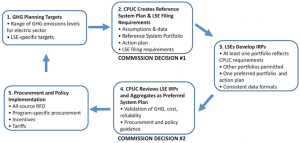
The CPUC proposes to elevate all that. Its proposal involves an iterative process to compile individual IRPs into one statewide resource plan—in other words, a resource plan using the state as its service area. This process seeks to balance the individual loads, generation resources, planning perspectives, power grids, and other aspects of each LSE—large and small, public and private—into one cohesive direction that focuses energy generation in the state.
Senate Bill 350, which initiated the CPUC proposal, requires an IRP development process that meets California’s greenhouse gas (GHG) emission reduction targets. The upshot, however, requires a modernized grid to transmit increasing amounts of renewable energy. Among many other goals, SB 350 calls for 50% renewable generation by 2030, essentially doubling current output. The pending SB 100 ups the ante by requiring 60% renewable generation by 2030 and a non-mandatory 100% by 2045.
Continue reading A Statewide Approach to Integrated Resource Planning
Greenhouse gas emission reductions, cost, and reliability are the drivers
Regulatory officials in California are raising the bar on integrated resource planning, taking it to a more efficient and effective level.
The California Public Utilities Commission (CPUC), together with the California Energy Commission (CEC), is guiding a process that helps each load-serving entity (LSE) collectively meet statewide energy, social, and environmental goals.
 CPUC staff have issued a proposal for implementing integrated resource planning across the state. This proposal, created with input from the LSEs, outlines a structured process for LSEs to develop IRPs and for the CPUC to review these IRPs. The CEC has also drafted IRP submission and review guidelines specifically for publicly owned utilities. These proposals must first by adopted by the Commissioners before taking effect.
How is the California IRP process different? From its very foundation, the IRP process being developed in California lays a stronger foundation than those employed by virtually any other state. Here are eight such building blocks:
Continue reading California: Working to Elevate Integrated Resource Planning
An actual conversation I had recently at a business organization meeting
He took my arm firmly, pulling me aside for a private conversation. I had been standing in a small circle with colleagues, talking, at a business organization meeting when he accosted me.
“So,” he started. “I understand you work with electric utilities.” More of a question than a statement.
It all happened so suddenly that I just looked at him. “Have we met?” I asked, mainly to gather myself.
 “No,” he said, then introduced himself. I returned the favor.
“I know who you are,” he continued. “You used to sit on an energy-related committee with my wife.”
“And she is…” I ventured.
He told me. Different last name. But now I understood the connection. They modernized older properties, and one of their initiatives is to lower the energy requirements of the buildings by integrating renewable resources and energy efficiency measures.
“Ah. Yes, I work with electric utilities.”
“Around renewable energy?”
“Mainly around integrating more renewable resources into the electric grid.”
“So you know a lot about rooftop solar photovoltaic panels?”
I have a social media habit. But it’s not the kind of habit you might think. It doesn’t encompass my every waking hour. I engage once in the morning and then pretty much leave it alone after that. Here’s what I generally do every day.
First, I start with Facebook. I scroll through to find anything interesting, especially posts from my three kids. Then I check out LinkedIn. Who’s invited me to connect? Who’s endorsed me? Who’s looked at my profile? I check out an article or a random post.
 I don’t muck much with Twitter except to search on #stcorg and #stc13 . After looking at these two searches, I usually just close it. I might check out Instagram, but usually only because one of my children has posted there. Next, I check out the ST C Board of Directors site to read any new posts. And I check my iPhone to see if there is any pushed content I find interesting.
One morning, though, things were particularly active. I kept getting new posts all over the place. Bing here, ping there, bop over there. (Ok, not audibly; metaphorically, but you get the idea.) I could barely keep up. For some reason that I didn’t totally fathom, I wanted to check them all out. It quickly became took much, moving back and forth, forth and back, that it all became, well … chaotic!
When that thought hit me, it just brought everything to a halt. Is social media just chaos, and we’ve all been sucked in to the flurry? While my computer and smart phone kept pinging and popping, I began to wonder. What if social media is a manifestation of the chaos theory? Well, that just might explain a lot.